Methodology

Our Methodology

Evidence-informed organisational intelligence for psychological safety, psychosocial risk and workplace wellbeing.

Vox Animae has been designed to help organisations move from disconnected feedback and reactive interventions toward structured, evidence-informed improvement. Our methodology brings together recognised workplace frameworks, organisational psychology and practical action planning, so leaders can understand what is happening, where support is needed and how to improve conditions over time.

Methodology in motion

How Vox creates organisational intelligence

Vox Animae does not simply collect survey data. Evidence is interpreted through recognised psychological frameworks, mapped to four reinforcing pillars, translated into targeted interventions, and reviewed continuously — so organisational learning compounds over time.

  1. Evidence

    Structured signals gathered through validated Vox Animae tools.

  2. AI Interpretation

    Themes, tensions and patterns surfaced across the connected evidence base.

  3. Four Psychological Safety Pillars

    Findings mapped to LMX, Just Culture, Safety & Wellbeing and Reward & Recognition.

  4. Recommended Interventions

    Evidence-based actions selected to address the specific conditions identified.

  5. Review & Continuous Improvement

    Impact tracked over time and re-fed into the next round of evidence.

Improvement cycle

From evidence to improvement

Vox Animae is built around a continuous cycle of evidence, interpretation, action, review and refinement. Each stage feeds the next, so organisational learning compounds over time rather than starting from zero with every new initiative.

  1. 01

    Evidence

    Structured signals from validated tools converge into a single evidence base.

  2. 02

    Intelligence

    Connected signals become organisational insight — themes, tensions and priorities.

  3. 03

    Action

    Insight is translated into targeted, proportionate interventions with clear direction.

  4. 04

    Review

    Trends and outcomes are examined to test whether change is landing as intended.

  5. 05

    Improvement

    Learning is embedded and feeds continuously back into the next round of evidence.

Continuous loop — improvement feeds the next round of evidence

Alignment

Built around recognised frameworks

Vox Animae is designed to speak the language of the frameworks organisations already work within. Explore each framework below to see the domains it covers and how the Vox Animae toolkit contributes evidence, structure and action.

Philosophy

A four-pillar approach to psychological safety

Vox Animae treats psychological safety as something that is actively built, not something that appears because an organisation runs a survey. Our methodology is organised around four reinforcing pillars: effective leader-member exchange, fair and just culture, safety and wellbeing, and reward and recognition.

Psychological Safety

Reinforcing foundations

The toolkit

Six connected tools, one methodology

Each Vox Animae tool covers a distinct layer of organisational insight. Open any tool to see its purpose, what it measures, the academic foundations underneath it, the outputs it produces, the pillars it supports and the interventions it typically informs.

How Vox turns conversations into organisational intelligence

From individual Vox tools to organisational intelligence

Preserving tool results, identifying cross-tool patterns and translating evidence into clear organisational direction.

1. Collect evidence

Individual tool outputs

Each Vox tool retains its own purpose, results and appropriate quality indicators.

  • Safe to Speak
  • Individual Check-In
  • Team Sync Charter
  • Workplace Mental Health Risk Assessment
  • Open Mic

All tool outputs feed one shared evidence layer. No tool belongs to a single pillar.

2. Understand the evidence

Framework findings and cross-tool themes

Two parallel readouts interpret the shared evidence layer.

Framework findings

  • Psychological Safety
  • SCARF
  • HSE Management Standards
  • PERMA
  • Just Culture and organisational-risk themes

Recognised frameworks remain visible in their own right and are not replaced by the Four Pillars.

Cross-tool themes

  • Communication
  • Trust
  • Workload
  • Recognition
  • Psychological Safety
  • Support
  • Fairness
  • Accountability
  • Inclusion
  • Proportionality

The Theme Engine identifies recurring patterns across independent tools and preserves the evidence trail behind each theme.

3. Interpret direction

Four Pillar direction of travel

The combined evidence layer can inform any pillar where methodologically justified.

  • Effective LMX

    Improving
    Momentum:
    Strengthening over two review cycles
    Evidence balance:
    More supporting than contradicting evidence
    Evidence base:
    Themes drawn from several independent tools
    Confidence:
    Placeholder — framework in development
    Supporting themes:
    Trust, Communication, Support
  • Fair & Just Culture

    Stable
    Momentum:
    Little movement since the last review
    Evidence balance:
    Balanced evidence, with local variation
    Evidence base:
    Themes plus Just Culture framework findings
    Confidence:
    Placeholder — framework in development
    Supporting themes:
    Fairness, Accountability, Proportionality
  • Safety & Wellbeing

    Declining
    Momentum:
    Deteriorating signals in specific areas
    Evidence balance:
    Contradicting evidence outweighs supporting evidence
    Evidence base:
    Themes plus HSE hazard findings and open cases
    Confidence:
    Placeholder — framework in development
    Supporting themes:
    Workload, Support, Psychological Safety
  • Reward & Recognition

    Mixed
    Momentum:
    Improving in some areas, weakening in others
    Evidence balance:
    Evidence points in both directions
    Evidence base:
    Themes reported across more than one tool
    Confidence:
    Placeholder — framework in development
    Supporting themes:
    Recognition, Fairness, Inclusion

The Four Pillars synthesise organisational evidence. They do not replace the original frameworks and are not presented as psychometric scales.

Current pillar intelligence remains provisional while the direction-and-evidence methodology is being finalised.

4. Support action

Executive briefing and priorities

Leaders receive a traceable summary of what is changing, why it matters and what action is supported by the evidence.

Organisational direction

Illustrative
  • Effective LMX

    Improving
  • Fair & Just Culture

    Stable
  • Safety & Wellbeing

    Declining
  • Reward & Recognition

    Mixed

Key insights

  • Leadership trust strengthening across teamsEvidence: Themes: Trust, Communication
  • Workload pressure affecting wellbeingEvidence: HSE Management Standards findings + Workload theme
  • Recognition experienced unevenly in operational rolesEvidence: Themes: Recognition, Fairness
  • Fairness perceptions vary by locationEvidence: Just Culture findings + Fairness theme

Recommended actions

  • Review workload allocation where hazard controls are incomplete
  • Extend recognition practice into operational teams
  • Test fairness perceptions locally before organisation-wide change

Every insight links back to the themes or framework findings that support it.

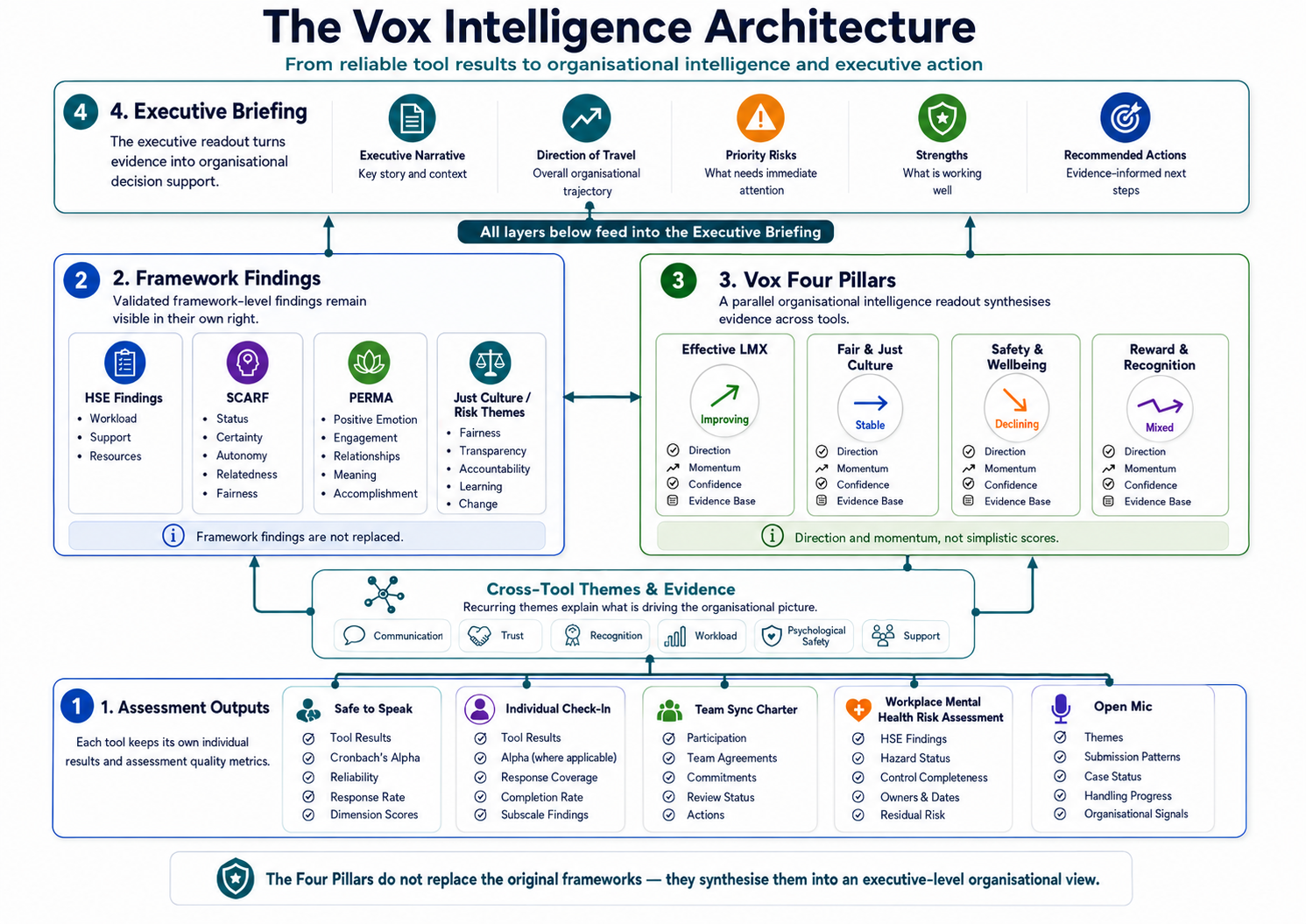
The Vox Intelligence Architecture: outputs from Safe to Speak, Individual Check-In, Team Sync Charter, Workplace Mental Health Risk Assessment and Open Mic feed a shared cross-tool theme and evidence layer, which informs framework findings and the Vox Four Pillars, both feeding the Executive Briefing.
The Vox Intelligence Architecture — from reliable tool results to organisational intelligence and executive action.

Explore the detail

The full methodology detail sits behind each panel below, so the overview stays readable at a glance.

Methodological safeguards

  • Tool results remain intact.
  • Cronbach's alpha is used only for eligible multi-item scales.
  • Recognised frameworks are not replaced.
  • Four Pillar intelligence is a synthesis layer, not a diagnostic score.
  • Current pillar outputs remain provisional.
  • Every conclusion is traceable to its supporting evidence.
  • Vox does not diagnose individuals.

Evidence, interpreted with care, becomes action

The ecosystem

One connected platform. Multiple tools. Shared organisational learning.

The Vox Animae tools are not standalone surveys. They form an organisational intelligence ecosystem where every interaction strengthens understanding and supports continuous improvement.

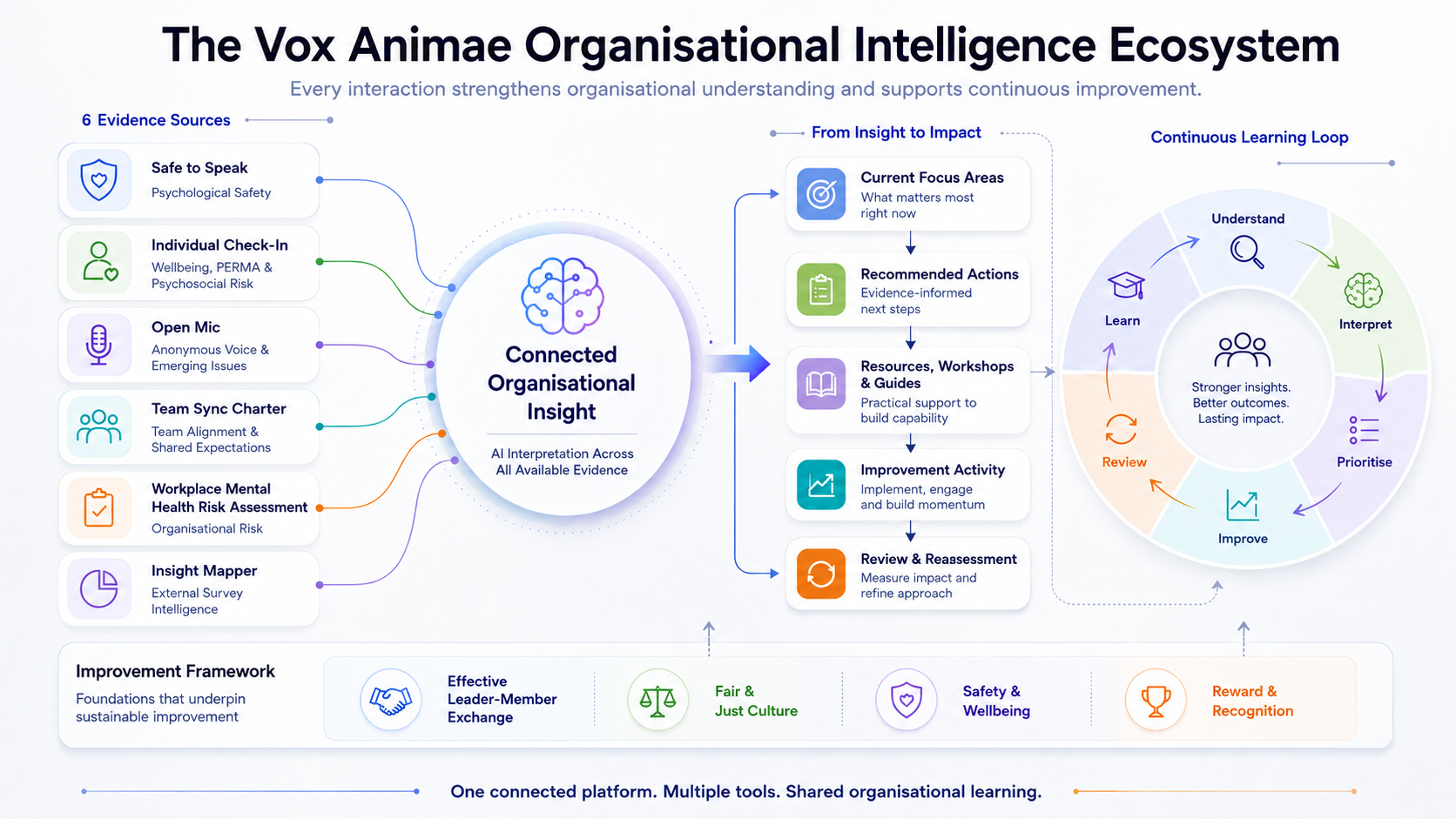
Diagram of the Vox Animae Organisational Intelligence Ecosystem showing six evidence sources feeding a connected insight engine, an insight-to-impact pathway, a continuous learning loop, and four improvement framework foundations.
Every interaction strengthens organisational understanding and supports continuous improvement.

Six evidence sources

Safe to Speak, Individual Check-In, Open Mic, Team Sync Charter, Workplace Mental Health Risk Assessment and Insight Mapper each capture a distinct layer of organisational signal — from anonymous voice to psychosocial risk to external survey intelligence.

Connected organisational insight

Signals from every tool flow into a single connected view. AI-supported interpretation works across all available evidence to surface themes, tensions and emerging issues that no single tool would see on its own.

From insight to impact

Insight becomes a clear pathway: current focus areas, evidence-informed recommended actions, resources and workshops to build capability, improvement activity to sustain momentum, then review and reassessment to measure impact.

Continuous learning loop

Understand, interpret, prioritise, improve, review and learn. Each cycle strengthens the next, so the organisation compounds insight over time rather than starting from zero with every new initiative.

Improvement framework foundations

Everything rests on four foundations that underpin sustainable improvement: effective leader–member exchange, a fair and just culture, safety and wellbeing, and meaningful reward and recognition.

Responsible interpretation

From data to insight

Vox Animae does not use AI to diagnose individuals or replace professional judgement. Instead, AI-supported interpretation helps summarise themes, highlight patterns and suggest areas for further exploration. The aim is to support better conversations, not automate decisions about people.

Responsible use

Confidentiality and responsible use

Vox Animae is designed around confidentiality, proportionality and responsible interpretation. Results are presented in ways that reduce unnecessary exposure of sensitive people data, using role-based access, aggregated reporting and small-group suppression where appropriate.

Non-clinical

Vox Animae does not diagnose or provide medical advice.

Aggregated insight

The focus is on patterns, not individual surveillance.

Action-oriented

The purpose is improvement, not measurement for its own sake.

Outcomes

Designed to turn insight into practical improvement

Organisations using Vox Animae move from ad-hoc feedback to a repeatable, transparent rhythm of understanding and action.

Clearer organisational signals

Better conversations

More targeted action

Visible review cycles

Stronger evidence base

Explore how Vox Animae can help your organisation understand, act and improve.